
Relays / Contactors
Relays / Contactors
We deal in various relays and contactors to support industrial requirement. Relays provide reliable switching for high-current circuits in solar, robotics, and EV battery systems. Choose from our compact, high-voltage models with blue heat-shrink packs for seamless integration.
- ✓ Electromagnetic Relay (EMR)
- ✓ Solid-State Relay (SSR)
- ✓ Reed Relay
- ✓ Thermal Relay
- ✓ Time Delay Relay
- ✓ Overload Relay
- ✓ Latching Relay
- ✓ Numerical Relays
- ✓ Differential Relay
- ✓ Distance Relay
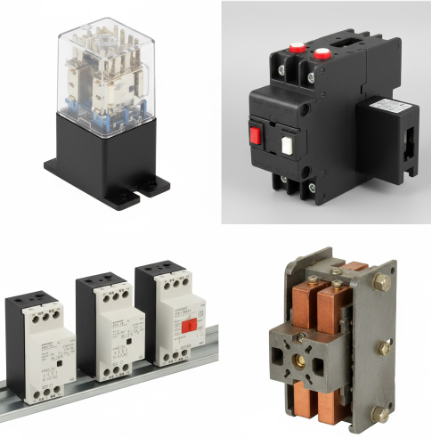
Contactors
Contactors are electrically controlled switches designed to handle high-current loads in motors, lighting, and power circuits. They ensure reliable control and protection in industrial automation and electrical distribution systems.
- ✓ AC Contactor
- ✓ DC Contactor
- ✓ Magnetic Contactor
- ✓ Thermal Overload Contactor
- ✓ Capacitor Duty Contactor
- ✓ Lighting Contactor
Relays and Contactors are both types of electromagnetic switches that use a low-power electrical signal (the control circuit) to mechanically open or close contacts in a separate, usually higher-power circuit (the main circuit). They both operate on the principle of an electromagnet (a coil) pulling an armature to move the contacts.
🎛️ Relay (The Low-Power Switch)
A relay is typically used to switch low to medium-current loads, generally less than 15 Amperes (A), and primarily functions within control circuits for signaling, isolation, or managing small devices.
- ✓ Load Capacity: Low current (e.g., controlling the coil of a larger contactor, small indicators, or simple electronic circuits).
- ✓ Contact Configuration: Can be designed with both Normally Open (NO) and Normally Closed (NC) contacts, and often have multiple poles (SPDT, DPDT, etc.) to manage several circuits simultaneously.
- ✓ Safety Features: Generally more basic, as the lower current reduces the risk of major arcing or welding.
- ✓ Size: Smaller and more compact, often suitable for mounting on printed circuit boards (PCBs) or in small enclosures.
🏭 Contactor (The High-Power Switch)
A contactor is a more robust, heavy-duty switch designed to handle high-current loads, typically above 15 A, and is predominantly used to switch power circuits for large equipment.
- ✓ Load Capacity: High current (e.g., directly starting and stopping large electric motors, high-power lighting systems, or heating elements).
- ✓ Contact Configuration: Primarily designed with Normally Open (NO) power contacts, ensuring the power circuit is safely disconnected when the coil is de-energized. They often include smaller auxiliary contacts (NO or NC) for control and signaling functions (like indicating the motor is running).
- ✓ Size: Generally larger and more rugged than relays to accommodate the thicker contacts and arc-suppression mechanisms.
- ✓ Arc Suppression/Chutes: Channels and extinguishes the electrical arc that forms when contacts open under high load.
- ✓ Spring-Loaded Contacts: Ensures a reliable and rapid break of the connection to prevent contact welding.
- ✓ Overload Protection: Often built-in or paired with thermal overload relays to protect the connected motor.
Safety Features: Includes enhanced safety measures due to high currents, such as: